Learn how to grade accurately
When purchasing used records it’s important to understand the grading system. Some refer to the “Goldmine Standard” of grading. This is the easiest and most used method. It’s fairly simple once you’ve looked at a few thousand records. Below is the Goldmine grading system with my comments in parenthesis. If you’re going to collect records than it’s a good idea to be able to know what you’re purchasing.
Note-I’m old. I say record a lot when referring to the vinyl. When I say album I’m talking about the cover and record together. When I say record I’m talking about the vinyl. I know people say Vinyls and it drives some old dudes crazy…. Call it what you want.
MINT
Vinyl: A record that is in perfect condition and has never been played. (This is reserved for Sealed Records only. New old Stock, Never Opened. It’s the only time that a record is considered Mint. Most 45’s are never considered Mint because they weren’t sold in individual shrink wrap. I have a few that were are in shrink wrap with a cardboard backer)
Cover: A cover that is in perfect condition and has no signs of wear or damage.
Near Mint (NM or M-)
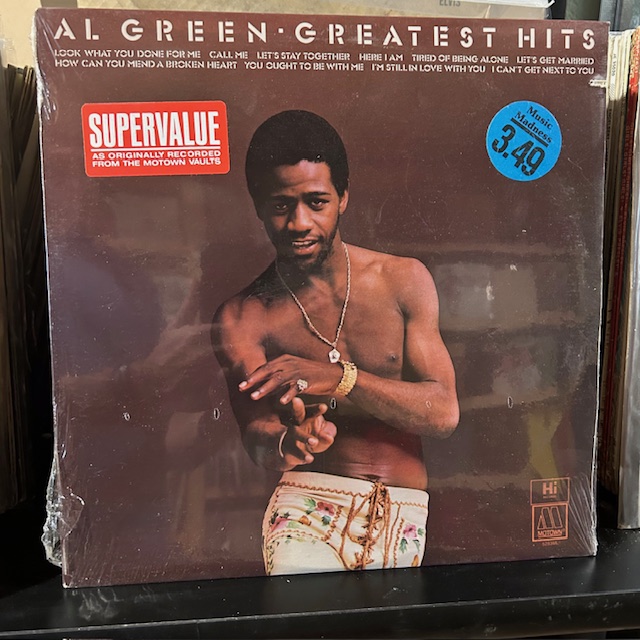
Vinyl: A record that appears to have never been played or has been played very few times. There should be no visible signs of wear or damage on the vinyl. (This is an album that is opened but the record looks perfect. It appears to be brand new without any signs of being played. It’ll be shiny and clean…with no fingerprints or light surface marks. Notice in the picture that there are no hairline marks on the record. None in the grooves and none in the deadwax. Dead wax is the area between where the grooves end and the label)
Cover: A cover that shows minimal signs of wear and is almost perfect. There may be slight creases or dings, but they should be barely noticeable.

Very Good Plus (VG+)
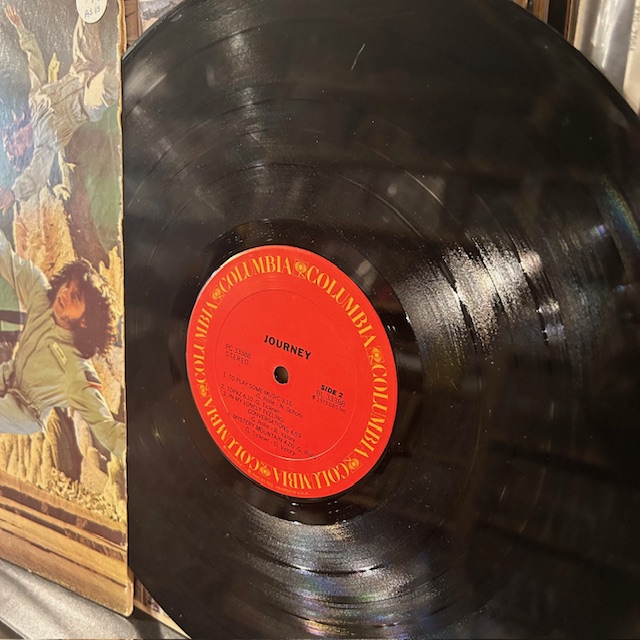
Vinyl: A record that has been played but is still in excellent condition. There may be some light surface marks or signs of handling, but they should not affect the sound quality. (Light surface marks are often referred to as hairline marks. These are usually caused by taking the record in and out of the dust sleeve. VG+ would only have a few and non are deep or can be felt. Notice the mark at the top of the record. It’s a light surface mark that probably won’t cause much surface noise. I usually play the record in that area to make sure that there isn’t a lot of surface noise or to ensure that the record doesn’t skip.)
Cover: Cover may be marred by a cut-out hole. Sleeves will have some slight wear, lightly turned up corners, or a slight seam split.
Very Good (VG)
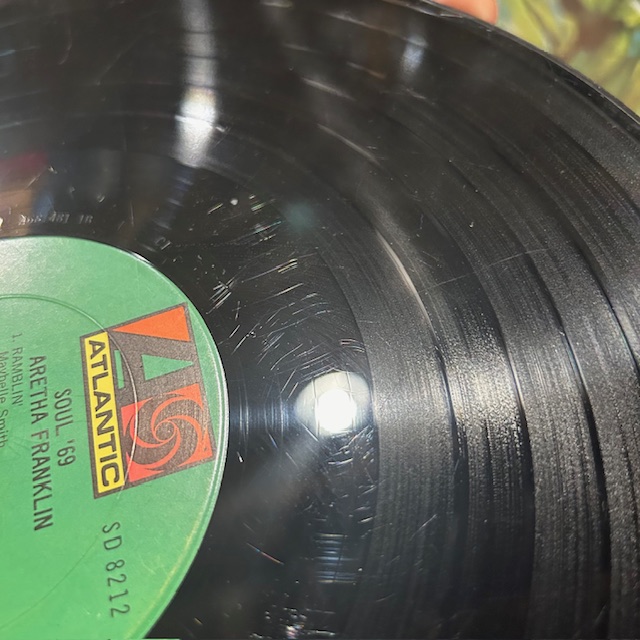
Vinyl: This has obviously been played. A record with light scratches that will affect the sound. Surface noise will be evident upon playing, but will not overpower the music otherwise. (More numerous surface marks on the record that will cause a static sound, crackling, clicks, pops, and other noises. This will also include groove wear. Groove wear is when a record was played a lot….the constant play will wear the record down and take away the pure sound when it was originally pressed. Notice the hairline marks in the deadwax and on the grooves. These will cause a static sound, or other forms of background noise like clicks and pops)
I usually don’t list or sell anything below VG since they are usually ones that people won’t collect unless it’s highly rare or valuable. These may be cracked or chipped. They are covered in surface scratches and usually have deep scratches that will cause skipping or skating of the needle. Yes there are times that a record that looks VG+ may sound VG. This is usually caused from groove wear, which is sometime difficult to detect. It can also be caused by a terrible original pressing. Some labels are notorious for having a bad press of an album during a certain time frame.
Know what you want when you start collecting. I personally only buy Mint (New), NM- and VG+. A few clicks and pops never bother me. I don’t mind occasional surface noise when I’m listening to a record but when it’s constant I want to tear it off of the turntable and put it in the repurposing pile.
Finally, Sealed and presumed Mint for older records is a common phrase. This means that a record was never opened. It’s presumed to be mint since there’s no way of telling the exact condition without looking at it. New Mint is a current release. They don’t all sound perfect. I’ve bought a few new ones that sounded terrible…. full of clicks and pops. I packed it back up and returned it to the seller.
Why Grading Matters
Grading is a way to describe what a record should sound like. You, as a buyer, wants the item accurately described to match your expectations. Just as important is the price. A Mint copy of Abbey Road that is an early release and sealed will cost hundreds of dollars. A VG+ copy will like by $30-$50. A VG of the same pressing will cost $5-$10.
Who You Buy From
You have control when purchasing records in person in record stores, or from local online sellers. You’re able to look at the records in person and determine the condition of the cover and vinyl. Always make sure that the album and cover match. I’ve come across so many that have a different album (Vinyl) than the cover when buying used albums.
Purchasing from online sellers is a way to find what you want from across the world. Learn who you can trust and provides an accurate grading and description. Read their reviews and what others have said about their buying experience. I don’t purchase a lot online but my least favorite place to buy is Ebay. There are a lot of good honest sellers on there but there are also a lot of people who don’t know records and how to grade them. They like to say that the records look “GOOD”. Good to me means garbage on the grading scale. “Very Good” is the most subjective category. Ones person VG is anothers NM- and someone elses trash. I think this is most common with the casual Flipper. Like “Man, those look really good” Meaning like new. While another says “Those aren’t trash so they’re VG”
The other problem I see is that there is a lot of assumption with grading. A seller comes across a box of classic rock albums and wants to assume that they are all VG or better. They tend to over grade the better or more desirable albums. I can’t tell you how many Beatles albums I’ve found that ended up in the repurposing pile (Below VG). Popular albums where played a lot.
Another problem is that a casual flipper won’t understand that the pricing matches the description. They see a that the album sells for $50. They don’t understand that these are selling at this price because they are NM-. They price theirs at $50 but not knowing how to grade, theirs could be VG or worse.
Happy Collecting
You know you. If you want a perfect sound than purchase new or NM- only. If you don’t mind a few clicks or pops then go to VG+ or higher. If you really like a song or group and don’t mind some background noise, you can go to VG or above. Purchase whatever your tolerance level can take.
Hopefully this helped explain the grading and what to look for. Feel free to ask any questions for clarification or share your personnel experiences with buying and what you look for.
 Outpost Record Shop
Leave a comment